Shadow IT, dette technique, dépassements de coûts : 3 risques que le Product Builder fait émerger
The post Shadow IT, dette technique, dépassements de coûts : 3 risques que le Product Builder fait émerger appeared first on Converteo.
Redesign phase 1: new theme, data-driven matrix, Hugo update - Replace hugo-theme-learn submodule with a custom theme in layouts/ (light blue/white, terminal-style accents, dark mode, self-hosted OFL fonts, no cookies, storage or third-party requests) - Move the status matrix into data/ (browsers, features, statuses, per-browser claims) with build-time validation - Add status chips, highlight/compact toggles, mobile card layout, per-browser "At a glance" summaries - Add Pagefind search, 404 page, breadcrumbs, last-modified dates and suggest-edit links - Migrate config.toml to hugo.toml for Hugo 0.154; deploy via GitHub Actions to Pages, with lychee link checks - Remove Cliqz and empty draft pages; keep old URLs as aliases
The post Le séisme organisationnel : comment le Product Builder déplace les rôles PM, dev et designer appeared first on Converteo.
Online & Mobile tracking
Today, the French data protection authority has fined Fnac Darty (one of the largest electronics retailers in France) €7 million for illegally using third-party trackers on its mobile app without consent. The fine is the result of a noyb complaint filed in 2023. In addition to France, Fnac Darty is also active in countries such as Spain, Italy, Portugal, Belgium, and Switzerland.
Background. In September 2023, noyb filed three complaints in France against the real estate app SeLoger, the fitness app MyFitnessPal and the electronics retail chain Fnac Darty. The reason: The companies’ apps illegally accessed and shared users’ personal data with third parties for sophisticated analytics as soon as the apps were opened. Users didn’t even have the choice to consent to or prevent the sharing of their data. Such extensive data collection allows the profiling of users in order to show them personalized ads and marketing campaigns to increase the revenue for the mentioned companies.
CNIL investigation into Fnac. Following these noyb complaints, the French data protection authority (CNIL) launched its own investigation into Fnac Darty in March 2024 – and confirmed the findings. According to the CNIL, Fnac Darty was “using a tracker – the placement of which the users had not consented to – which, amongst other things, collected their browsing history in order to display product recommendations to them and to train its recommendation algorithm.” The CNIL restated that the processing of personal data for targeted advertising requires users’ consent. In this case, it confirmed that Fnac Darty had tracked users without obtaining their consent.
Lisa Steinfeld Leiser, data protection lawyer at noyb: "The CNIL made once again very clear that processing people's data for personalised advertising requires consent. While this kind of tracking remains a widespread practice, we hope that this decision sets the tone for cases of illegal tracking.”
€7 million fine. Based on these findings, the CNIL now fined Fnac Darty €7 million. According to the authority, the electronics retailer has failed to comply with its legal obligation to ask people for their consent. In case of non-compliance with the decision, Fnac Darty faces a daily penalty of €10,000.
It is time for a new acronym to enter the marketing lexicon: OAO.
We have lived in the Search Engine Optimization (SEO) world for the longest time – it remains critically relevant. Many of us have embraced the new demands of Answer Engine Optimization (AEO). [I’m sorry, I’m not a fan of Generative Engine Optimization (GEO) because that honors the technology and tech changes all the time.]
Organic Answers Optimization, bringing the two worlds together… Because they really are one thing now.
Big brother SEO is still dominant – most traffic, most revenue. Little brother AEO has “stolen” “market share” in the consumer influencing game (no need to come to our sites ☹️), has started to drive modest scale in traffic and a surprising scale in profit.
Practitioners in each space fight surprisingly passionately to preserve their respective SEO and AEO domains. It. Is. Ok.
For me, the business person, it is now just one thing:
My SEO work drives AEO, and AEO drives SEO. The brothers (or sisters, if you prefer), united in strategy, execution, tactics, impact, and analytics.
Different “machines,” one quest: Organic Answers Optimization!
It makes it easier to make peace with this:
Your SEO traffic is likely down 20%-30% YOY (as I predicted!).
Your AEO traffic is up from 0% to 2% (as I predicted).
Overall “organic” revenue is down (unless you did most of the 12 SEO and 8 PPC recommendations, in which case Rev up ~10%).
I want to bring these two together, from a business perspective, because “organic” deserves extra special attention. Even bigger declines in traffic are on their way.
Around this time last year, I wrote a six-part (!) series on AEO, AEA (Analytics), and a three-part series on how to identify the upcoming losses, take actions for recovery, and compute the financial impact.
[Annual Premium Subscribers: I have converted all this into an updated 114-page Answer Engine Playbook! If you would like the PDF version of the mini-book, please email me.]
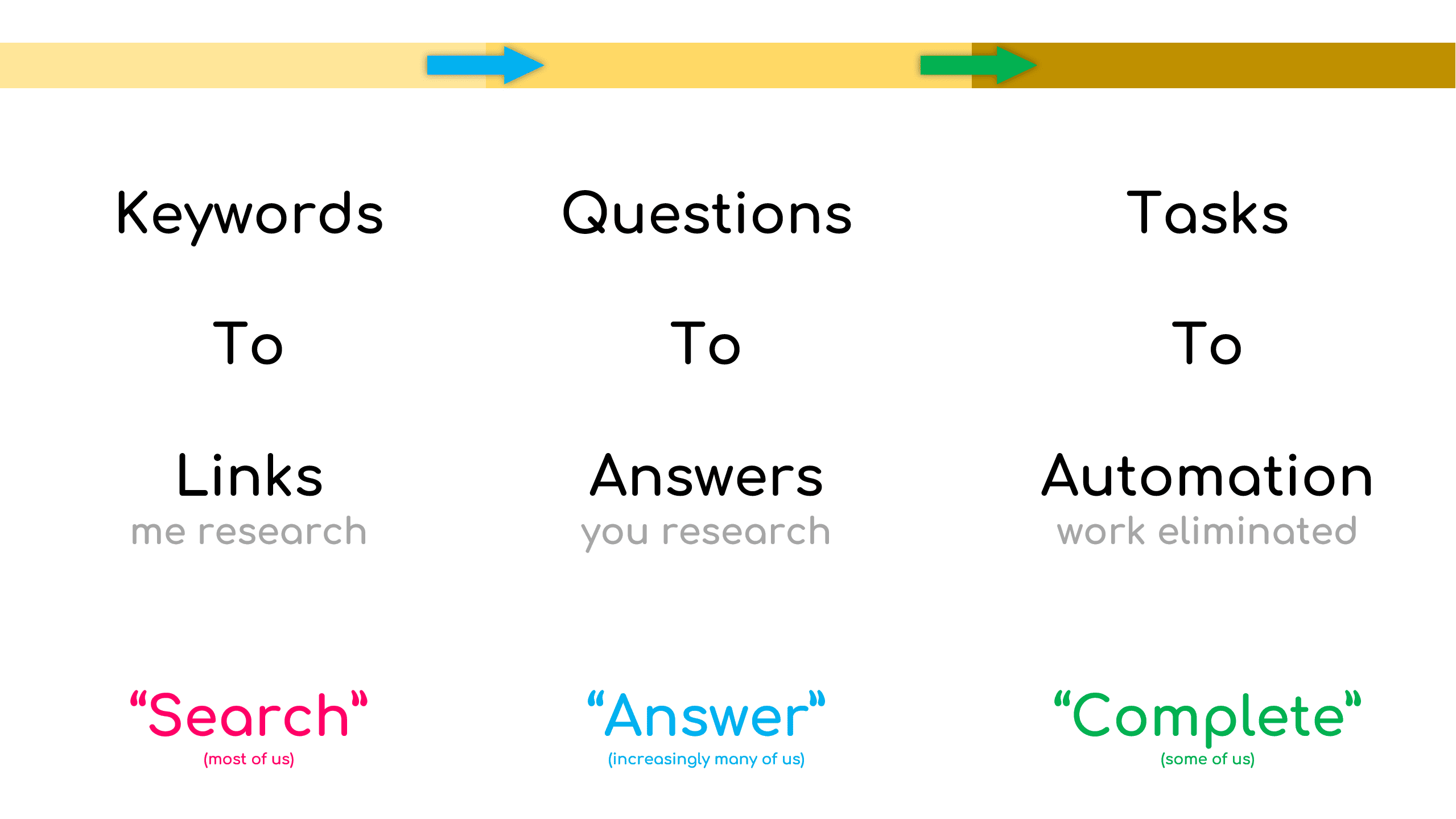
In a keynote I subsequently delivered, this picture captured the evolution:
Let’s say I have an upcoming trip to Prague.
Old-school search would have me going to Big Google and searching for “lightweight carry-on luggage.” I’ve been patterned to use keywords to get back three paid links and ten organic links, and then head off on a research mission to find the right suitcase.
Most of us do this (a billion plus).
Along with approx. 50% of GenZ who use an LLM every day, I stopped doing searching 18 months ago. I now pop open ChatGPT and type “ I need a light carry-on for a ten-day trip, with a small European airline connection, for under $250. I also need a backpack that I can stuff with extra clothes and a laptop, to go with the bag that the small EU airline will allow me to carry on.” Astra (my GPT model) is now off to the races, and 17 seconds later I have my answer. No research, no sweating.
A few hundred million of us, skewing young, are doing this.
[Bag: Travelpro Maxlite International Carry-on Spinner. Backpack: CabinZero Classic Tech 28L. Both look amazing. I’d never heard of CabinZero: the discovery power of an LLM.]
Increasingly, I skip the buying part customers doent do it. Same context-rich query as above, but I might add “ …buy the first recommendation for each, confirm it will arrive by Oct 30th, from a site with a clear returns policy.” Often, the purchase shows up. Sometimes the site blocks my Agent from buying, so it adds to cart and sends me the link.
1% to 2% of us are doing this.
The world is moving right, because why would a human need to spend time hunting and gathering, the meal can arrive all caught, plucked, seasoned, and cooked?*
With Dots and Muse, the pace will pick up.
*Some people find joy in shopping; they will continue to have this option!
Your customer does not care if they used Old Google or used an Answer Engine. For them, they were just seeking, and they found what they wanted.
[Per SparkToro, approx. two-thirds of US Google searches end without a click.]
Your CFO does not care about Old Google or Claude or Qwen. They care that we are chosen and get revenue.
[Per Adobe, with a trillion US retail visits analyzed, LLM-driven visits deliver 53% more revenue per visit than other channels. Per Shopify, LLM-driven visits convert approx. 50% better than Organic Search.]
Your Marketing team does care because you have an SEO team/agency and, if you read my mini-book, have a raft of AEO initiatives in your Content team. And these are silos today because the work used to be different. SEO, which you already know all about, had an emphasis on 1P and text plus images. AEO was built on that strong foundation, and added an emphasis on 3P and video plus audio.
As customers delegate more, a visit to your website becomes a less complete record of your influence. Hence, pulling it all into one scorecard will provide a fuller view of influence, and create incentives for your silos to break.
One more reason… For now, the first strong commercial results from your “AEO” efforts will flow in through your “SEO” traffic. Unification helps here too.
Learning is better when we have an actual use case. Kettle & Loom is a made-up home goods retailer. K&L’s CMO was given a report with three numbers:
1. Search Console Clicks: -14%
2. Agency Visibility Score: +9%
3. Organic Revenue: +2%
Is that good? Bad? Yes. 😊 Let’s learn.
For our unified scorecard we need metrics. BUT. Methodologies trump metrics!
Let’s do that first.
There is no one ring to rule them all. At this stage, we will have to pick and choose from a basket – and there is a lot of “variable” quality out there.
Your owned systems (GA, CRM, ERP) describe visits, behavior, sales and profit, mostly to entirely accurately. Search Console describes observed Google Search performance – often aggregated or hidden for privacy reasons. Competitive tools estimate things about other sites that your analytics can’t see – hence, they’re best for comparison, never for raw numbers.
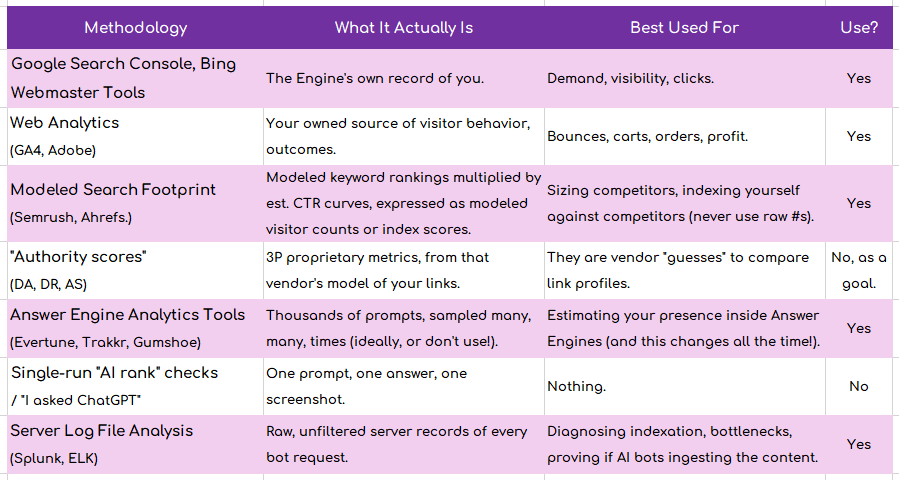
It is important to reflect on methodologies carefully because it really is a case of GIGO. And, in our world of immense scale, it is more like garbage in, landfill out.
It is particularly critical for Answer Engine Analytics tools as they are so new. Investigate how they collect data. [Premium Subscribers please see: TMAI #472: AEA Methodologies & KPIs. If you can’t find it, please email me.]
There is a lot of snake oil out there. Ex: Some vendors claim, or STRONGLY imply, that they have full access to actual prompts typed by users of LLMs. That is simply a lie.
Panels of a few mil can be somewhat useful at extremely aggregated levels. Ex: Industry. Even by category in an industry, it falls apart. For a single brand in a category in an industry, it is just crap.
Even a large panel will see 0.01%, or significantly less, of ChatGPT’s July 2025 publicly stated 2.5 billion prompts. For every MILLION times a question is asked about your category, a vendor claiming “tens of millions of prompts captured” will catch about 100, and only single digits, at best, will be about you. Worse news? The monthly “search volume” of any one prompt is effectively one.
One day we might have “Claude Webmaster Tools,” or “OpenAI Seeking Console,” but until then… no dice.
SEO also has issues we have learned to be careful about. Marketers constantly mistake estimated traffic, authority scores, and visibility indexes – all proprietary vendor guesses – for Google’s actual ranking mechanics (falling victim to Goodhart’s Law).
K&L’s Agency Visibility Score of +9%? Their vendor’s model of rankings * estimated clicks. Some value in comparing against direct competition. It is not proof of any extra dollars.
Everything in AEO for now, at least, is a “long tail query,” but we also don’t get such queries from Google – these hidden rare queries add up to nearly half of all clicks (Ahrefs). 3P SEO tools that “model” this long tail data should be viewed with suspicion. Google now mixes AI Mode questions into the same report, unlabeled (and rare, hence, more likely than not, hidden).
K&L’s -14%? Real clicks. But brand and non-brand are blended. AI Mode sits inside, unlabeled, and nearly half the queries are hidden. That number is a mush of all that.
Just because a source is not perfect does not immediately mean it is useless. Understand. Use metrics from the methodology at the signal strength it offers.
Humility Note: Organic Answers Optimization is funneling demand that in large part was created by brand advertising, distribution, seasonality, word of mouth, yada, yada, yada.
K&L’s +2% organic revenue? 50% of it comes from brand searches, and most likely from non-S&A EO initiatives.
KPIs are metrics that directly impact the bottom line. Typically, they are for people who fund things. They tend to move over months and quarters. They are most influential – or you are doing them right – when they have pre-set targets.
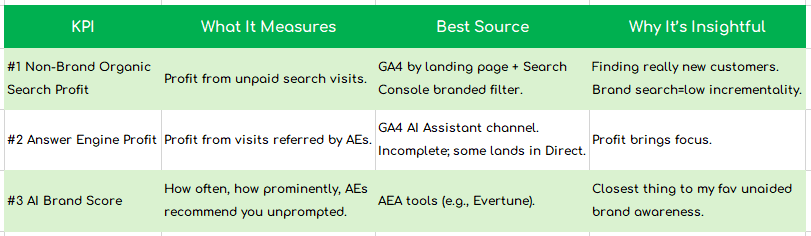
For organic traffic, across all machines, from an ocean of metrics and fuddy counts, I recommend three KPIs (you should rarely have more than three):
KPI #1: Non-Brand Organic Search Profit.
Measures profit from orders (or leads) that began with an unpaid search visit from someone who did not search for your brand/product/service name.
Best source of this data: GA4 by landing page + Search Console branded filter + GA4 AI Assistant channel. It is imperfect, but as good as it gets.
[Premium Bonus: Please see TMAI #521: GA 2026: Unlocking New Value re how to improve GA’s ability to report LLM traffic more accurately using my AI True Traffic Total Kit.]
Why insightful: Following my humility note above, the real job of OAO is to help find and deliver people who didn’t know you – brand demand has extremely low incrementality.
Action recommended: Set targets for this number, then fund SEO initiatives against it (to mostly slow down declines in Organic Search traffic – using, among other things, ideas in my Loss/Recovery spreadsheet model).
Pro-tip: You can translate KPI #1 into Rental Cost. Non-brand organic clicks * what you’d pay per click for the same queries = What it would cost you to rent an asset you own!
KPI #2: Answer Engine Profit.
What it says on the tin.
Best source of this data: Site analytics tools, AI Assistant channel. This is incomplete (mid-Oct ChatGPT decided to change referral strings), and a bunch of it lands in Direct. But. We have to start somewhere.
Why insightful: Is the trend Adobe and Shopify have identified, higher conversion rates and AOV, happening in your case? Profit numbers bring focus.
Action recommended: Use it to gain investments in content (especially video, audio, especially brand, especially 3P). This data can help you persuade your sometimes stubborn, old-school Tech teams to focus on technical AEO, unblock robots and Agents.
Pro-tip: It is really hard to quantify, but most AEO content investments will initially return as a reduction in SEO declines (hence more SEO revenue).
KPI #3: AI Brand Score.
An approximation for how often AEs recommend you, and how prominently, when the question doesn’t include your name. It combines Visibility Score with Average Position.
Best source of this data: From tools like Evertune*, a probabilistic answer gained from repeated prompts to identify a distribution of answers the machines provide. 100 = your brand named first, every time. What’s yours?
What it isn’t: It doesn’t claim to know what your customers type. Nobody knows that.
Why insightful: The number closest to the Most Important Marketing KPI ever: Baseline for Unaided Brand Awareness. You can also think of it as your share of an LLM’s shelf.
Action recommended: I believe the insurance against all the changes coming is my strategy of more content, more places, more often (details in my AEO mini-book). AI Brand Score measures progress against this faith in future influence and revenue. Hence, proof for your CFO that content investments are worthy.
Pro-tip: Tag every major model release on your AI Brand Score chart. A new model can swing you ten points instantly – without changing anything fundamental. Don’t take credit, or blame, for the AI’s homework.
*A long time ago, I made a tiny, tiny, tiny angel investment in Evertune because the team’s awesome.
Let us reflect on K&L’s measurement and apply the lessons above…
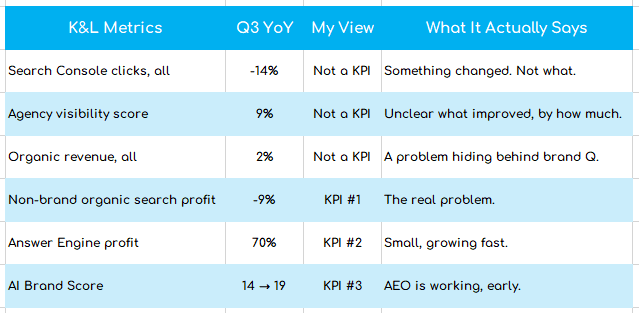
K&L’s CFO will ask the obvious next question: why is non-brand profit down? Did K&L lose rankings? Did Google keep the click? Or did customers take their questions to LLMs and never click at all?
TMAI Premium #532 built a simple triage process, entirely from data K&L already own. This quickly helps us identify challenges/opportunities each month. The next step is to drill down to diagnostic metrics and influencing variables that K&L’s agency should be acting on. For larger brands, TMAI #533 also pulled out of SEO the contribution AEO makes to reducing declines or increasing growth.
The journey ends with your awesome OAO Analytics dashboard:
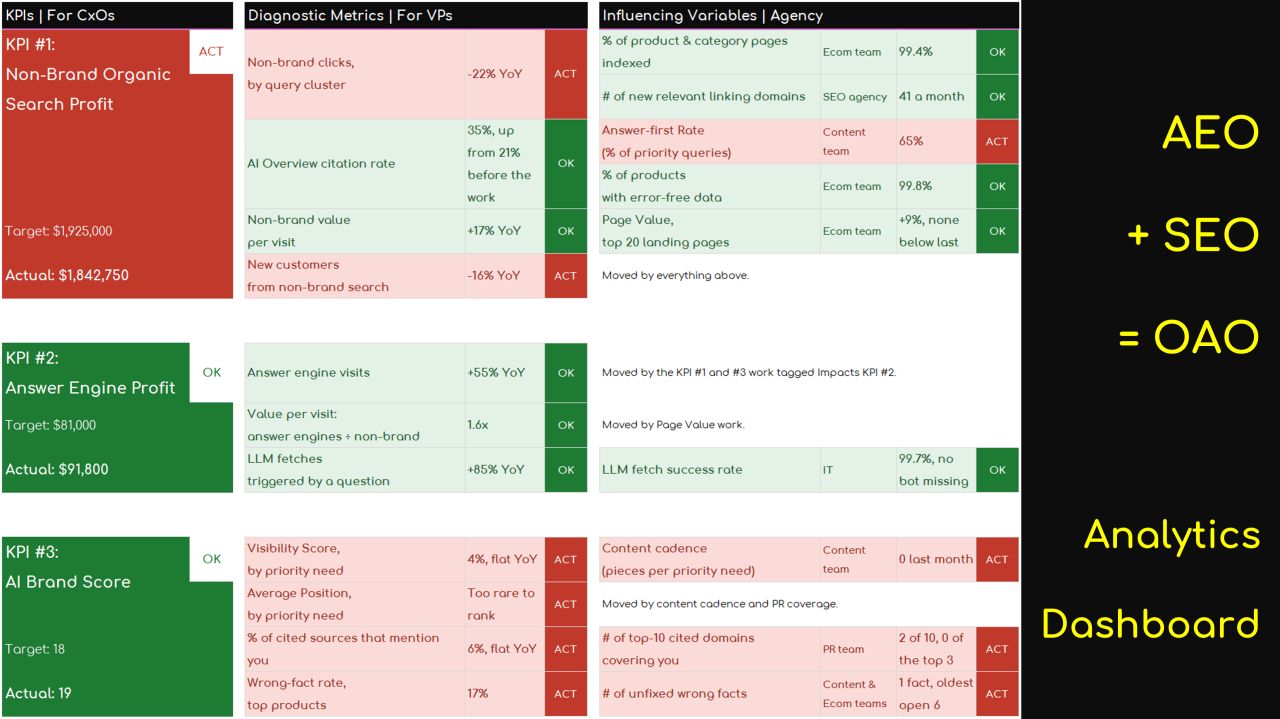
The mini-book worth of stories put together reduces faith required in my OAO strategy of more content, more places, more often – by providing data.
This is the
Premium Subscribers also received an Excel workbook to use across VPs, Directors and agency peers to activate SEO+AEO=OAO revolution. To get a copy sign up here, and reply to the welcome email.
As humans move from Search to Answer to Complete, the cascading impact on businesses is immense. It’s hard to appreciate for now, because Search remains dominant – especially for older demographics (who have all the money!).
My hope with my little new acronym, OAO, is to encourage a focus on change to ensure change does not catch you by surprise – delivering a business shock.
Faith + Data will prevent surprises.
Carpe diem.
Google Brand Lift & Conversion Lift studies use the same underlying idea of statistical certainty. But certainty is not the same thing as answering the business question that matters most: if you spend the money again, how likely are you to reproduce the result?
Let’s start with a phrase that causes me to cringe every time I hear it: “directional results.”
It sounds sophisticated. Nuanced. Even reasonable. But what does it actually mean?
Answer: Just about anything you want it to mean!
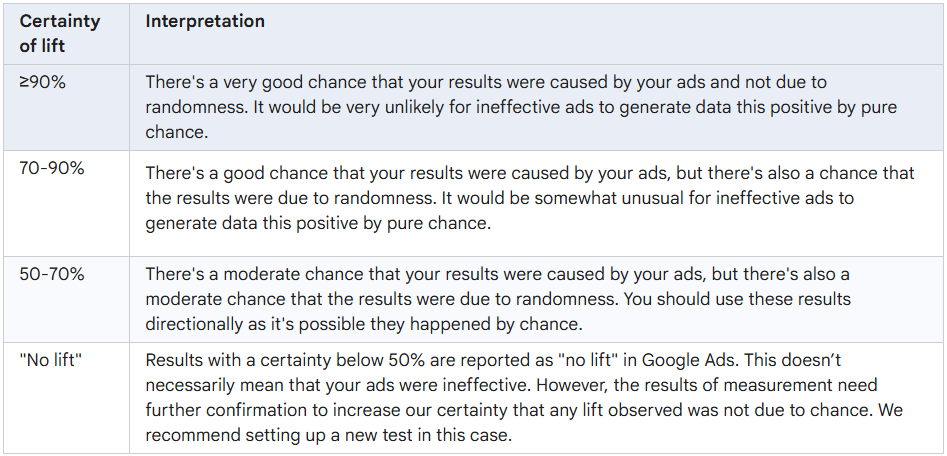
I was reminded of this while reading Google’s official guidance on how to interpret Google/YouTube’s Brand Lift, Search Lift, and Conversion Lift studies.

It made me pause. Then sad. Read the last one carefully.
Google says: ≥90% is “very good chance.” 70%-90% is “good chance.” 50%-70% is “moderate chance.” Your ads probably did something good.
The last layer is, paraphrasing: Hey, the ads might not have sucked, spend some more and let’s see what happens.
Google also says in the article: Studies at 50%+ can provide valuable, directional insights, and explicitly tells advertisers in the 50%-70% band to use the results directionally.
If you pause and reflect on this carefully caveated article, you’ll see this is a case of: Heads Google wins, tails you lose.
To bring this lesson home, let’s assume I ran a campaign on YouTube.
Google calls 70%-90% Certainty a “good chance.” It also says studies at 50%+ can provide “valuable, directional insights.”
What. The. Heck. Does. Directionally mean?
From Google’s view, the interpretation is that there is a “good chance the results were caused by your ads.” But as a Senior Director of Brand Media, is a “good chance” good enough for me to report to my CFO and ask for $5 mil more?
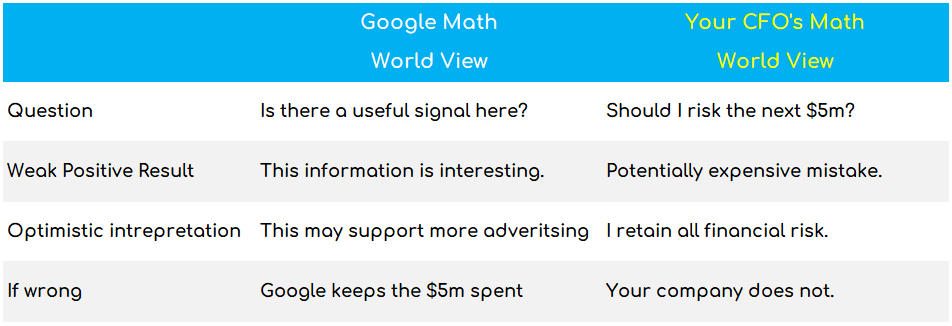
Party One: Google: It sells advertising. If a study contains weak evidence that advertising could possibly have worked, Google has every incentive not to throw it away. Perhaps, and that’s the operative word, perhaps there is something useful to learn. Fair enough.
Party Two: You: You own the Marketing budget. Your job is not to find something interesting in the data. Your job is to answer: IS the evidence in YouTube’s BLS strong enough that I should risk another $5 million of my company’s money on the conclusion that the first $5 million worked?
Here, I made a little table to outline incentives and implications:

It is impossible to know if Google’s wording on its sites, in its client decks, is intentionally self-serving. It does not matter. The outcome is self-serving.
Google does not bear the consequences of an optimistic interpretation. Your company does. Google also, to their credit, has a drive-by line that says: Guys, interpret results based on your business needs and risk tolerance.
Since I am bearing the risk, for consequential business decisions I use 90% Certainty as the floor. It isn’t magic; it is simply the minimum level of evidence I’m willing to accept before telling a CMO or CFO: “This worked. Spend again.”
[Premium Subscribers: Refer to TMAI #298: Smarter Statistical Significance Reporting. It includes a one-pager to standardize stat sig reporting across your team, agency, vendors. If you can’t find it, please email me.]
Google’s emphasis is on “moderate chance,” “good chance,” “directionally.” These are comforting, decision-sounding words that obfuscate evidence more than illuminate it. The language is for sure carefully caveated, but it ignores the immense risk and cost it intentionally or unintentionally shifts onto Google’s clients.
Let me prove it to you.
Rather than discuss p-values associated with “good chance,” “moderate chance,” “use these results directionally,” let’s focus on the question your CMO and CFO care about:
If we ran this campaign again with another $5m budget, how likely is it that we will get a result strong enough to confidently say: “Round two worked. Spend again.”
You’ll recall YouTube reported a +3-point lift in Consideration at 70% Certainty.
While they might not use the technical phrase, your CMO and CFO are essentially asking: What’s the Replication Risk?
[For this thought experiment, we’ll assume, the second $5m will face the same underlying conditions as the first $5m. Same platform (doh!), audience, seasonal factors, promotions, creative, sample size, etc.]
To compute Replication Risk, I’ll use a simple Bayesian replication model inspired by biostatistician Steven Goodman. It helps translate Google’s abstract “Certainty” into a much more practical question: What might happen if we measure the same thing again?
YouTube’s BLS estimated a +3-point lift in Consideration. But +3 is an estimate; rather than pretending it is precise, the Bayesian approach carries that uncertainty forward into the next measurement.
As business owners, it is our money on the line. We are applying this simple logic:
(Uncertainty from what the true effect might be)
combined with
(Uncertainty from measuring it again)
= How confident should we be that we will see similar results?
Let’s do some math!
Three computations for the Business Owner lens:
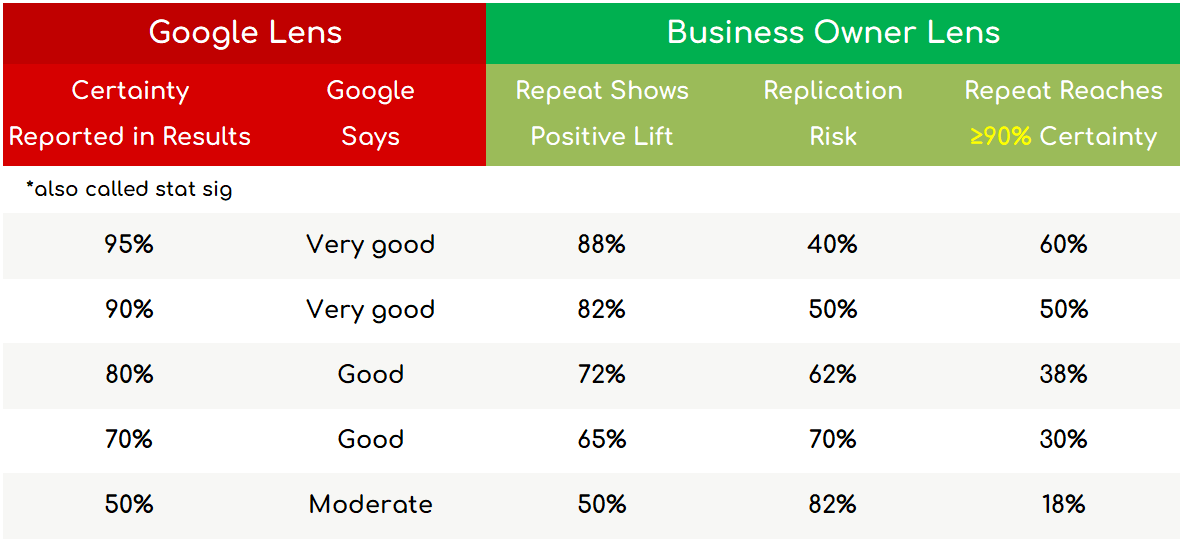
1. Repeat Shows Positive Lift: The probability thta an equivalent repeat produces any positive lift, even a tiny, tiny, tiny +0.01 points – an extremely low bar.
2. Repeat Reaches ≥90% Certainty: The probability that an equivalent repeat produces ≥90% Certainty – my minimum standard for evidence strong enough for us to spend again.
3. Replication Risk: Simply the opposite of #1. The probability that the repeat falls short of the ≥90% standard.
Human language: What are the chances I spend another $5m, and still don’t get a result with certainty for me tell my CMO or CFO, “This worked. Spend again.”
Punch to the gut: If your Replication Risk is 70%… There is only a 30% chance that spending another $5m will result in you telling your CMO “This worked.” #killmefirst
Google vs. You: Google calls 70% Certainty a “good chance.” The replication math shows the “much, much less than good chance” you’ll take in round two.
Here’s the model using a simple Bayesian replication model inspired by Mr. Goodman:

[Pedantic Note: Google says displayed Certainty is rounded down in 5-point increments. So a displayed 70% can represent 70% to just under 75% and hence the exact replication % can move a few points. For simplicity, I treat Google’s displayed Certainty as exact.]
YouTube had reported 70% “Certainty,” follow the row above… That “good chance” Google label translates into:
1. Just a 65% (!) chance of any Positive Lift, with a
2. A puny 30% chance of hitting high certainty,
3. when repeating the same spend ($5m) under the same conditions.
As a business owner, would you feel confident saying yes, let’s spend on YT again?
Forget Google for a second, take me: I recommend a minimum of 90% Certainty for a business decision. That comes with a Replication Risk of 50% (!!) and Repeat Shows Positive Lift of just 82%. Too uncomfortable in many cases (what if it was a $10m question, would you take 50% and 82%?)
Now Alex and Juliette understand why I so often push for 95% Certainty. When you spend as much money as we do on YouTube… At least get the Replication Risk down to 40%, increase the Repeat Shows Positive Lift to 88% and increase the odds more in the company’s favor.
If you have real money riding on it, look at column 3, look at column 5 in the table, see if you want those odds. If you have little to no money riding on it, sure – go try a new hypothesis, design a different/better test, give additional money to Google/YT/Meta/TT, remeasure.
A bonus relevant lesson from “Beyond Power Calculations: Assessing Type S (sign) and Type M (magnitude) Errors”: Weak evidence can hurt twice: The evidence may not survive (70% in our case), and the apparent impact might be overstated (+3 in our case).
You’ve been warned.
I want you to be able to see all the formulas and math I’ve used in my computation of Replication Risk.
I want you to be able to test lift’s Certainty AND Magnitude (Repeat Shows Positive).
I want you to be able to type in the results of your Brand Lift, Search Lift, and Conversion Lift studies and calculate your own truth (before you put your career on the line).
To enable all this, I’ve built a working model with Read Me + Methodology, Calculator, Risk Table, and Calculate Your Truth tabs. It is a bonus for TMAI Premium subscribers; please just email me for lift_replication_risk_model.xlsx.
Google and you are sitting on opposite sides of a consequential decision.
Google sells advertising. You are spending money.
Google might reasonably find value in evidence that is merely suggestive. See the first table. You have to decide whether that evidence is sufficient and measured credibly enough to risk the next tranche of your budget.
Don’t let an advertising platform’s definition of useful information become your company’s definition of sufficient evidence.
Stop outsourcing your tolerance for risk to the company selling you ads or the Agency whose fees are tied to the size of your spend.
Carpe diem.
PS: We have used Google’s specific table and specific guidance today. Replication risk applies just as much to Meta, TikTok, and confident calcs your Agency is sending you. Please check just as carefully if they are solving for themselves or you.
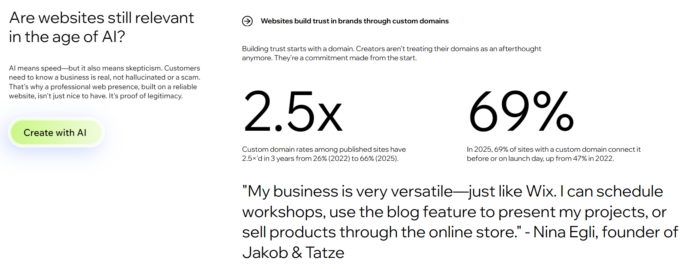
AI has made it easier than ever to create a website, generate content, and put a brand online. That speed comes with a new challenge: consumers have more reason to question what they see.
A convincing business can appear online almost overnight. For customers, a website therefore has an important job beyond selling products or services. It can help establish that a business is real.
Wix’s first State of Websites report, based on data from more than 300 million users, examines how websites are being built, discovered, and used in the age of AI. The report found that websites remain central to business growth, even as discovery expands across AI platforms and other channels.
For marketers, the takeaway is straightforward. Website credibility still matters. The challenge is making sure a website provides the information, content, and technical signals that support trust with both people and machines.
AI search is changing how people find information, but it hasn’t eliminated the need for a destination where customers can verify what they’ve learned.

Wix’s research describes a growing tension around AI and website creation. Building a site is becoming faster, but customers still need confidence that a business is legitimate.
A consumer might discover a company through an AI recommendation, social platform, or traditional search result. Before making a purchase or contacting the business, they may visit its website to confirm that the company exists and learn more about what it offers.
That makes a website part of the validation process.
A professional domain, clear business information, useful content, customer reviews, and evidence of expertise can all contribute to website trust. These signals help answer a basic question that becomes increasingly important as AI-generated information becomes easier to produce: Is this business real?
The Wix report found that AI platforms are increasingly interacting with websites. Its data shows that LLMs still account for less than 1% of website traffic, although traffic from LLMs grew fourfold between 2024 and 2025.
Traditional search remains much more significant. Search accounts for 42% of traffic to Wix sites, compared with 40% from direct traffic and 13% from social.
This puts the current state of discovery into perspective. AI search is growing quickly, but traditional search continues to be a major source of website visits.
For brands, that means the website still needs to serve both audiences: people arriving directly or through search and AI systems looking for information to use in their responses.
The report highlights several website characteristics associated with stronger business performance.

One of the clearest findings concerns structured data.
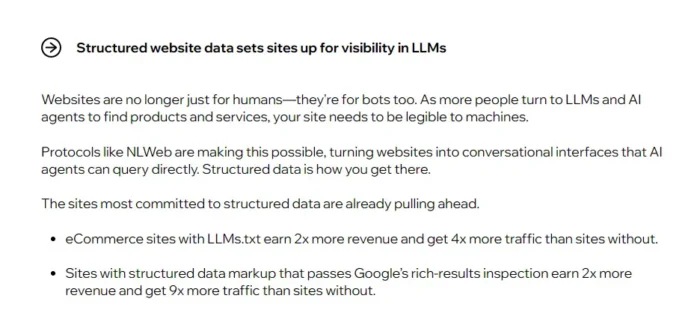
Wix found that sites with structured data markup that passed Google’s rich-results inspection earned 2x more revenue and received 9x more traffic than sites without it.
This is a correlation in Wix’s dataset, not evidence that adding structured data directly causes those outcomes. Still, the finding reinforces the importance of making website information easier for search engines and AI systems to understand.
Structured data gives machines additional context about the information presented on a page. As search experiences become more sophisticated, that machine-readable layer can help make important information easier to interpret.
For brands investing in AI visibility, technical foundations such as structured data should therefore remain part of the conversation.
The report also found that content remains closely connected to website performance.
Sites with blog content were 5x more likely to generate ecommerce sales and 5x more likely to secure bookings. Sites with 50 or more blog posts received 7x more monthly sessions than sites without a blog, with organic search serving as the primary traffic source.
These findings reinforce why useful content remains valuable even as the search environment changes.
A blog gives a brand space to answer customer questions, demonstrate expertise, publish original insights, and build topical authority. Over time, that content can also give search engines and AI systems more information to understand and reference.
Reviews provide another signal of credibility.
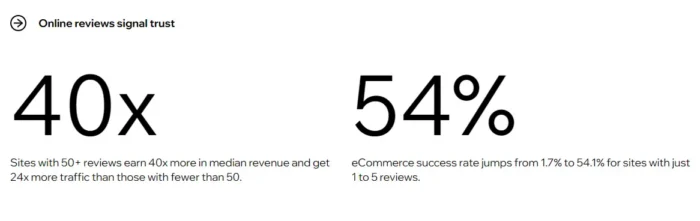
Wix found that sites with 50 or more reviews earned 40x more median revenue and received 24x more traffic than sites with fewer than 50 reviews. The report also found a substantial increase in ecommerce success rates among sites with even one to five reviews.
Reviews aren’t simply a conversion tool. They provide evidence that real customers have interacted with a business.
Combined with useful content and a professional website, customer feedback can help reinforce the legitimacy that consumers are looking for when evaluating a brand.

The findings suggest that marketers shouldn’t treat website development, SEO, and brand credibility as completely separate priorities.
A website should give visitors a reason to believe that a business understands its industry.
That can include educational articles, original research, customer stories, product information, reviews, and other content that demonstrates genuine experience.
This content also creates more opportunities for a brand to appear in search. Wix found that organic search remains the largest source of website traffic across its dataset, accounting for 42% of traffic.
A website now needs to communicate with more than human visitors.
Search engines crawl its pages, while AI systems and agents increasingly access website information when answering questions or helping users make decisions. Wix reports that AI platforms ping nearly 700,000 Wix sites each month, generating 2.2 million sessions in March 2026.
That makes machine readability an increasingly relevant consideration.
Marketers should review structured data, page organization, metadata, and other technical elements that help systems understand what a website contains.
The report points toward several practical areas marketers can address.
Review the information a new customer would encounter when visiting your website for the first time.
Is it immediately clear who the company is, what it offers, and how customers can contact it? Are reviews, credentials, case studies, and other evidence of expertise easy to find?
These details contribute to the overall experience of evaluating a business online.
Look for gaps in the content that customers and search engines need.
Develop useful resources around important questions, publish original insights where possible, and make sure commercial pages provide enough context to support purchase decisions.
Wix’s data suggests that blogs can be strongly associated with traffic and business outcomes, particularly when sites build a substantial library of useful content.
Technical SEO should continue alongside content development.
Review structured data implementation, indexing, page structure, and other elements that help search engines and AI systems interpret your site. NP Digital is also exploring newer approaches to machine readability, including reviewing LLMs.txt where appropriate and identifying opportunities to make valuable content easier for AI systems to access.
The objective isn’t to optimize a website for machines at the expense of people. It is to make the same useful information accessible to both.
The rise of AI doesn’t make a website less important. In some ways, it raises the stakes.
When anyone can create a convincing business presence quickly, a website backed by real content, customer experiences, reviews, and clear business information can provide an important layer of credibility.
The Wix data reinforces that websites continue to generate meaningful traffic and business results. Search still drives 42% of website traffic, blogs are associated with stronger business performance, and sites with validated structured data show substantially higher traffic and revenue in the report’s dataset.
We’ve always built content for trust and authority and that’s exactly what AI rewards now. In a world where anyone can look like a business overnight, a website built on real content and reviews is what proves you actually are one.
The role of the website is evolving, but its fundamental purpose remains. It gives customers a place to learn, verify, and decide.
Website credibility helps customers determine whether a business is legitimate and trustworthy. Clear business information, useful content, customer reviews, and evidence of expertise can all contribute to that trust.
Not necessarily. AI is changing how people discover businesses, but websites remain an important destination for validation and further research. Wix’s data found that search still accounts for 42% of website traffic across its dataset.
Structured data gives search engines and other systems additional information about the content on a page. Wix found that sites with structured data markup that passed Google’s rich-results inspection earned 2x more revenue and received 9x more traffic than sites without it.
Yes. Wix found that sites with blog content were 5x more likely to generate eCommerce sales and 5x more likely to secure bookings. Sites with 50 or more posts also received 7x more monthly sessions than sites without a blog.
AI is changing how consumers discover businesses, but it hasn’t removed the need for a credible web presence.
Websites continue to serve as a place where customers can verify a business, research its offerings, read reviews, and decide whether they can trust it. At the same time, the information on those sites increasingly needs to be understandable to search engines and AI systems.
For brands, that means investing in website credibility remains valuable. Strong content, customer reviews, technical foundations, and structured data can help create a site that supports both human decision-making and the evolving requirements of AI search.
If you want to strengthen your website’s trust signals and prepare your organic strategy for the evolving search landscape, reach out to the NP Digital team to learn how content, technical SEO, and AI visibility can work together.
The post Le guide pour prouver la rentabilité de vos budgets média avec le MMM appeared first on Converteo.
The post MCP Contentsquare : ce que les équipes CRO peuvent vraiment en attendre appeared first on Converteo.
The post Commerce agentique : vers la grande désintermédiation des marques ? appeared first on Converteo.
From 10 December 2026, the new Australian Privacy Principle (APP) 1.7 in the Privacy Act 1988 (Cth) will require entities to disclose the use of automated (or substantially automated) decision-making (ADM) in their privacy policies.
Disclosure is required where computer programs are used to make decisions, or do things substantially and directly related to making decisions, that could reasonably be expected to significantly affect an individual’s rights or interests, and where personal information is used in the operation of the computer program.
If the test above is met, APP 1.8 requires the following information to be disclosed:
On 30 September 2026, the Office of the Australian Information Commissioner (OAIC) published guidance on the forthcoming ADM transparency obligations. Key takeaways from the guidance include the following:
Examples of ADM use cases where the OAIC considers that disclosure may be required include:
Importantly, the OAIC has emphasised that the disclosure obligations are not onerous. If in doubt, entities should err on the side of transparency and adopt an inclusive approach when updating their privacy policies. The assessment underpinning the decision to disclose (or not) is the key exercise that the OAIC wants businesses to undertake.
Rather than treating particular technologies, decisions or activities as automatically within or outside scope, businesses operating in Australia should use the OAIC’s guidance to identify where ADM is being used in their operations, and determine whether each use case meets the threshold for disclosure. The way that businesses use software, tools and other computer programs can also change over time, and so any decisions on the applicability of APPs 1.7 – 1.9 should be reviewed on a regular basis.