Something didn’t sit right with me, though. One of the accusations in that last fight was “you don’t respond to my texts,” which didn’t feel right to me – and, as a matter of fact, it was me who felt that way.
The strangest thing is that so many people have independently made this extraordinarily weird defect in judgement. That is because they haven't independently made this decision. Claude/Etc. has done all of the judgement for them, hence the bizarre distribution in logical errors.
There's something important to be said here about how many people have Claude/GPT make design decisions for them, and how AI is the primary decision maker in the world right now. You've got this bizarre case of "Decision Schelling Points" where a method of solving a problem is extremely overrepresented, because it's what Claude does out of the box.
I found 3D printing in 2023, at a workshop run by IBOS, the Danish Institute for the Blind and Partially Sighted. I expected a room full of other blind people. I was the only one. It turned out the workshop was for sighted people, teaching them how to make things for blind people.
That was when I got hooked. Suddenly I could feel what a building looked like. Braille could be printed for almost nothing. Emergency maps, which hang on almost every wall as flat pictures, could be made into something I could actually read. If sighted people could learn to make these things for us, I could learn to make them myself.
That is why I started Accessible3D. It has two goals. The first is to make objects that blind and visually impaired people can actually use and enjoy: things with braille, with texture, with shapes that carry meaning. The second is to show sighted designers that accessibility is not an extra feature you bolt on at the end. It is a design choice, and it makes objects better for everyone.
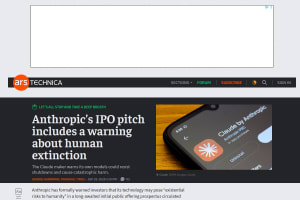
Anthropic has formally warned investors that its technology may pose “existential risks to humanity” in a long-awaited initial public offering prospectus circulated with a small group of partners in recent days.
Some AI models already exhibit signs of “model collapse,” which is where AI models further trained on AI-generated text can become worse and worse. In this case, some of the people hired to partially stop that happening are themselves using AI-generated responses to train OpenAI’s models.
Who could have predicted Bluesky could ever have run that risk? I mean, apart from everyone warning us that it was launched by weirdo alt-right blockchain-shilling AI-loving shitbird Jack Dorsey, and that their current CEO came from a weirdo alt-right blockchain-shilling AI-loving shitbird background. You know. Besides them.
if you ask a mobile team “is your app healthy?”, you’ll probably get a 20-minute technical briefing that involves crash rates, ANRs, Apdex scores, CPU utilization, and a handful of other metrics that make total sense to engineers and mean absolutely nothing to everyone else in the building.
To be clear, those metrics are useful! But they don’t do what Core Web Vitals do.
Standards were supposed to eliminate browser-specific code. We dug ourselves out of the IE era, celebrated, and then built exactly the same hole again around a different browser. Only now the browser-specific code lives in the browsers that aren’t dominant, patching over a web built for the one that is.
The spirit of openness, clarity, and technical depth that defined it has been overshadowed by commercialisation and integration. I understand how this happens - it’s a familiar story for beloved tools after acquisition - but that doesn’t make it any less disappointing.

 Connexion