❌

Vue lecture

noyb win: French electronics retailer Fnac Darty fined €7 million

Online & Mobile tracking

Today, the French data protection authority has fined Fnac Darty (one of the largest electronics retailers in France) €7 million for illegally using third-party trackers on its mobile app without consent. The fine is the result of a noyb complaint filed in 2023. In addition to France, Fnac Darty is also active in countries such as Spain, Italy, Portugal, Belgium, and Switzerland.

Mobile Apps

Background. In September 2023, noyb filed three complaints in France against the real estate app SeLoger, the fitness app MyFitnessPal and the electronics retail chain Fnac Darty. The reason: The companies’ apps illegally accessed and shared users’ personal data with third parties for sophisticated analytics as soon as the apps were opened. Users didn’t even have the choice to consent to or prevent the sharing of their data. Such extensive data collection allows the profiling of users in order to show them personalized ads and marketing campaigns to increase the revenue for the mentioned companies.

CNIL investigation into Fnac. Following these noyb complaints, the French data protection authority (CNIL) launched its own investigation into Fnac Darty in March 2024 – and confirmed the findings. According to the CNIL, Fnac Darty was “using a tracker – the placement of which the users had not consented to – which, amongst other things, collected their browsing history in order to display product recommendations to them and to train its recommendation algorithm.” The CNIL restated that the processing of personal data for targeted advertising requires users’ consent. In this case, it confirmed that Fnac Darty had tracked users without obtaining their consent.

Lisa Steinfeld Leiser, data protection lawyer at noyb: "The CNIL made once again very clear that processing people's data for personalised advertising requires consent. While this kind of tracking remains a widespread practice, we hope that this decision sets the tone for cases of illegal tracking.”

€7 million fine. Based on these findings, the CNIL now fined Fnac Darty €7 million. According to the authority, the electronics retailer has failed to comply with its legal obligation to ask people for their consent. In case of non-compliance with the decision, Fnac Darty faces a daily penalty of €10,000.

  •  

EU Member States (and Google) suddenly want to keep cookie banners!

GDPR Policy

For years, users and many companies have been complaining about cookie banners. Even though this understandable frustration is mostly caused by misleading dark patterns used by the industry, these banners have become the symbol of what is perceived as excessive EU regulation. As part of the ‘Digital Omnibus’, the European Commission now finally wanted to get rid of cookie banners and replace them with an automated signal. However, Google and some of the very EU Member States that are actually calling on the EU to “simplify” and “cut red tape” – including Germany and France, for example – are now standing in the way. In the Council’s latest position paper of 18 June, the plan to abolish the cookie banner has been scrapped. This baffling outcome is likely to continue to cost European users a great deal of hassle, frustration and billions of clicks per year.

EU Council Browser Signals

“Dark patterns” and annoyance until the right result. In Europe, users cannot simply be tracked. Both online and offline, there is a fundamental right to data protection – including on Meta’s or Google’s platforms, as well as on websites full of tracking adverts. Companies must therefore ask each individual for their consent – or simply leave them in peace. This is done via so-called cookie banners, whereby consent is not only sought for cookies, but usually also for the sharing of data with often thousands of third-party companies. Users should actually have the option here to consent only if they wish to be tracked online of their own free will. Depending on the study, only around 3–10% of people want this. However, through so-called dark patterns (e.g. hidden ‘No’ buttons or pre-ticked consent boxes), the tracking industry achieves consent rates of up to 90%.

With more than 450 million people in the EU, this farce generates several billion (!) clicks a year, causes frustration and is a complete waste of time for consumers – whilst tech giants and the tracking industry rake in billions in profits through “voluntary” tracking. At the same time, it is becoming increasingly clear that the massive harvesting of personal data also poses risks to security and democracy.

Max Schrems: “Cookie banners are not an invention of data protection, but of the tracking industry. Without consent, there is no snooping online. Now there are fears that a simpler way of saying ‘yes’ or ‘no’ will result in a loss of revenue for Google and the like. That is why the tracking industry is currently lobbying as hard as it can to keep the cookie banner. Clearly, it wants to retain the ability to directly manipulate users’ choices.”

The EU's proposal: an automatic signal. In autumn 2025, the European Commission proposed replacing cookie banners with an automated signal that would communicate cookie consent preferences between the device, the user and websites. Even in California – the home state of most tech companies – a similar solution is already in place. Various proposals adapted to EU law have also been around for some time. The EU proposal is actually significantly less radical than the laws in the US because it still allows for consent to be given on a per-website basis. Specifically, the newly proposed Article 88b GDPR would have provided the solution and was a simple example of how reducing red tape can succeed whilst simultaneously benefiting consumers and fair businesses.

Max Schrems: “Browsers already automatically communicate which language I prefer. It’s just as easy to indicate digitally whether you want to be tracked. Technically, this is straightforward and is even enshrined in law in some US states. There are actually a number of technical solutions that could be introduced tomorrow. Europe is lagging completely behind with these antiquated banners. Absurdly, however, Google and the tracking industry want to make it as difficult as possible for people.”

The “Google Paper” and an avalanche of misinformation. However, a secret lobbying paper from Google has thrown a spanner in the works for the European Commission. Using completely far-fetched figures, it argues that without cookie banners, all online advertising would come to a standstill. Google is exaggerating wildly here and assumes there is a central ‘kill switch’ for all advertising. Yet the European Commission has explicitly made it clear that consent should still be possible on a per-website and per-purpose basis. It would therefore be possible to grant consent to quality media outlets in particular – and to withhold it from Google, Meta and the like. Google conveniently ‘overlooks’ this. Particularly absurd is Google’s argument that quality media outlets would suffer from the abolition of cookie banners. Media outlets are exempt from the provision and would therefore not be affected at all.

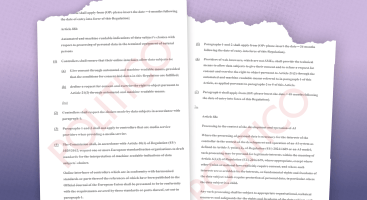
Excerpt of the latest Council position on Article 88b

Germany, France and others are now in favour of (!) the cookie banner. However absurd and transparent the arguments of the tracking lobby may be, they seem to have had the intended effect. In the proposal for a final vote in the Council, Article 88b was removed entirely from the Digital Omnibus – and with it, the only measure that would actually have simplified things for consumers. Countries such as Germany, France and Poland had demanded this in advance – presumably following massive pressure from the tracking lobby.

Max Schrems: “You really have to let that sink in: the European Commission finally wants to get rid of cookie banners, but Google and some EU Member States are now determined to keep them. For decades, people have been complaining about EU bureaucracy. But in reality, the tracking industry is so terrified of consumers being able to simply say ‘no’ that, after a bit of lobbying, everyone gives in. It really does raise the question of whether some Member States are primarily representing their voters or the lobbyists.”

The European Parliament has not yet taken a position. The ‘Digital Omnibus’ is currently still the subject of parallel negotiations in the Council and the European Parliament, although the latter has not yet made its position on Article 88b known. At the end of the negotiations, the two institutions will then have to reach a compromise. It is therefore essential that the European Parliament now advocates for the retention of Article 88b. However, here too, the conservative EPP is likely to tip the balance, as it is also under pressure from the tracking lobby.

Max Schrems: “In a democracy, what the majority of people want should actually happen – in this case, getting rid of cookie banners. If decision-makers prefer to follow the will of the tech lobby rather than that of their voters, then something is very, very wrong here."

  •  

Digital Omnibus reality check: 83.5% of access requests not properly answered

Data Subject Rights

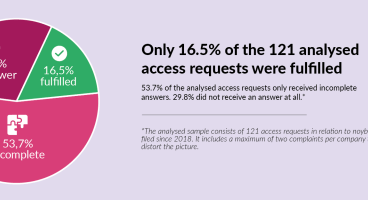
The most commonly exercised right under the GDPR is the right of access to one’s personal data that is being processed by companies. After all, it’s often the prerequisite to know if there is inaccurate or unlawful personal data that needs to be corrected or deleted. However, a new analysis of noyb cases shows: Only 16.5% of all access requests noyb has sent to companies in the past 8 years received a satisfactory reply, while 53.7% of replies were incomplete – and almost 30% were not answered at all. In other words: while companies are lobbying Brussels to limit people’s right of access because of an alleged “abuse”, the real problem is non-compliance by these exact companies.

Access Requests Statistics Header

No “abuse” by data subjects, but by companies. Following intense lobby pressure (especially by the German industry), the European Commission’s Digital Omnibus proposal argues that there’s a need to restrict data subject rights under the GDPR. Most notably, the proposed changes include a limitation of the right of access (in Articles 12(5) and 15 GDPR) to “data protection purposes”, which is justified with an allegedly wide-spread “abuse” of this right. This means, for example, that if an employee uses an access request in a labour dispute over unpaid hours – for example, to obtain a record of the hours they have worked – the employer could reject it as "abusive". In practice, this would massively limit the rights that Europeans have against companies.

Max Schrems: “The European Commission has fallen for a heavily abused lobbying narrative that the right to access is constantly being ‘abused’, when in reality it is largely companies that violate these laws.”

Real-life data: 83.5% of access requests not properly answered. In practice, however, the primary problem concerning the right of access is not “abusive” complaints, but the huge amount of requests that don’t receive a proper answer. This also explains why a significant number of complaints before authorities concern the lack of a full reply to access requests. To gain more insight into how companies deal with the right of access, noyb analysed 121 access requests that have been filed in relation to noyb cases since 2018*. The results are clear: only 16.5% of those requests received a satisfying reply, while 53.7% were incomplete – and almost 30% were not answered at all. Overall, 83.5% of requests were not answered in line with the law.

Only 16.5% of the analysed access requests were fulfilled

Big Tech takes your data, but doesn’t want to give you access. Noticeably, a lot of the analysed access requests were filed with big tech companies, which usually have automated tools to deal with requests. Nonetheless, most of them either received an incomplete reply or none at all. We observe this issue across all noyb cases – and the results would likely be worse for data subjects without legal representation or the resources to send multiple follow-up requests. Our cases against TikTok, AliExpress and WeChat provide a perfect example for this: Despite multiple follow-up requests to an incomplete response to an access request, the companies still failed to fulfil the initial request. This made it impossible for the complainants to check whether their data has been processed in line with the GDPR. Another good example is our case against the advertising broker Xandr (a Microsoft subsidiary), which reported an astonishing 0% response rate to access and erasure requests in 2022.

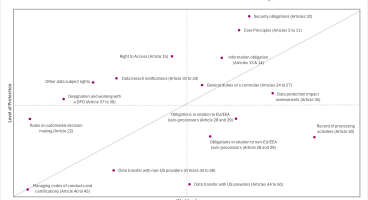
Access Requests not a relevant workload. At the same time, a recently published noyb survey  made clear that the majority (over 70%) of Data Protection Officers (DPOs) working in companies think that data subject rights – and the Right of Access in particular – don’t create a significant workload, while being a useful tool for protecting people’s rights.

Workload vs Level of Protection

Nothing is final. Fortunately, the Commission’s proposals to change the GDPR are just that: proposals. The Digital Omnibus is currently still being discussed in the European Parliament and in the Council and has already received significant resistance. noyb continuously works to preserve and strengthen data subject rights. After all, this analysis clearly shows that the authorities’ enforcement of (and compliance with) the Right of Access is already lacking. A further restriction would hurt millions of people in Europe.


*Note on the methodology: we analysed all access requests that have been filed in relation to noyb cases since 2018. Then, we made sure to only include a maximum of two requests per company to not distort the picture. This left us with 121 access requests.

  •  
❌