❌

Vue lecture

My Interop 2027 Picks

Interop 2027 is gathering votes and the deadline is 19 November 2026. For the second year now, Firefox made a page to let you rank your Interop 2027 choices. Which I’ve now done.

I narrowed it down to fifteen, though getting there was oddly difficult. It seems the top three are really what matter, but I’ll share all fifteen with some tiny amount of context for each.

Mine

Ranked.

  1. ariaNotify():
    Because years of watching developers get live regions wrong (arguably because companies aren’t employing screen reader users in critical roles) coupled with confusion about exposure and support, makes me hopeful this new approach will help close some of those gaps. The ARIA Working Group put in a bunch of effort to spec ariaNotify() (from an early odd proposal), so I look forward to broad support.
  2. HTML focusgroup attribute:
    I’ve shared my opinions on focusgroup, so I am hopeful for better outcomes for users, while simplifying keyboard patterns for authors (and hopefully less scripting).
  3. Shadow DOM referenceTarget:
    Because I have seen so many broken associations across shadow boundaries that have left screen reader and voice control users stranded. While ARIA reflection and the proposed AOM continue to get some attention, they aren’t here today.
  4. HTML headingoffset and headingreset attributes:
    Because headings coming from user-generated or third-party content are often the wrong level, though they aren’t typically blockers for users. That said, my fear is authors will get more cavalier, even treating this as an outline algorithm.
  5. Device Posture API:
    While foldable phones named Duo have been around for years, Apple’s newest hardware is already causing problems with design systems that (wrongly, IMO) rely on known and fixed screen sizes. I feel this can help limit user pain caused by author error.
  6. Viewport Segments API:
    For essentially the same reason as the prior entry, with the added bonus of numbers.
  7. CSS linked parameters:
    This is an author feature to me, because I use plenty of SVGs referenced by <img> and hate that I cannot pass colors into them.
  8. CSS AccentColor system color reflects accent-⁠color:
    There was a brief period where some design systems leaned on this user preference, and thanks to fingerprinting concerns, are stuck with low-contrast browser defaults instead. Some of those patterns aren’t getting updates, so let’s fix it in the place that broke it.
  9. CSS line-⁠clamp property:
    Card designs have been visually clipping text or moving interactive controls to the wrong place for years, making for confusing UIs for keyboard and screen reader users. While I am wary of letting CSS generate content (localization risk), I’d still like to see card usability improved and this might jelp.
  10. HTML <input type="week">:
    Again, this is a personal preference given how many poorly-coded, inaccessible date pickers I have seen. Adding a week option might seem trivial, but I’ve yet to see an author get it right.
  11. CSS random-⁠item() function:
    Not having to use script for this would be nice, though there is risk authors will use it for more than basic styling, potentially messing with exposure to AAPIs.
  12. CSS anchor positioning with transforms and animations:
    The script payload to do this well seems to cause my phone to overheat and my fans to spin, so seeing this handled natively would be nice as an author and user.
  13. CSS flex-⁠wrap: balance:
    To fix a years-old and glaring (IMO) gap in flex.
  14. Responsive iframes:
    This is an accessibility issue, in my experience, once critical content is visually hidden. Even when scrollbars appear, it’s a visual and functional mess.
  15. Improve interoperability of pointer events on touch devices:
    This only made the list because Apple is finally making a touch-screen Mac and, if VoiceOver is any indication, will fail to use what it learned on mobile and probably invent new interactions because it knows better. Maybe this proposal can get ahead of that behavior.

There are plenty of items I didn’t rank. There are plenty of items I would down-vote if I could. Regular readers of this site could probably guess a few.

Others

Others have shared their own rankings, so I’ve listed them alphabetically by last name for no particular reason (though I realize it’s only people with last names that I’ve found so far, kind of doubling down on the Western Wide Web phenomenon):

None of those rankings are wrong. Except where they are wrong, of course.
  •  

#Corpowid and #Skynet Technologies Will Get You Sued

The market is flooded with so many accessibility overlays that it’s impossible to keep up. I’ve written about the biggest players (plus some also-rans) and provided enough technical details that most readers should know how to quickly evaluate their false claims and poor technology. Never mind their ethical failures as business models.

So today is a two-fer, with no more free consulting telling these companies how to improve their products. They have not followed any advice I’ve offered over the years, other than temper their claims ever so slightly.

Corpowid

I’ll let Corpowid demonstrate its features using this 21 second silent video I recorded when I activated its overlay. See how many visible WCAG violations you can spot. Hints — my window is 1,280px wide and watch the arrows.

Fake transcript (hidden because spoilers for sighted users)

Viewing a Corpowid blog post, zoomed 200%, with overlapping text and graphics (Google for Startups, AWS Startup Programs, NVIDIA Inception Program, Visa Innovation Program) in its footer. There is a horizontal scrollbar. The bottom left corner has a floating button that animates new icons into it and flashing curved black “Try widget now!” text around it. When the overlay is activated, a crowded set of buttons with a tiny scrollbar that I miss when first trying to activate it appears. Finally I scroll to the right to show much of the navigation is off the screen, with a play button that pulses a purple border along with a block of text on the main page (“Book an accessibility consultation”) that also has a never-ending pulsing purple border.

Corpowid’s accessibility statement is attenuated to sound good to layfolk, but absolve itself of legal risk with squishy terms like:

In the end, if the overlay introduces WCAG violations and the company behind the overlay can’t itself follow nor commit to WCAG, then this is another case of paying to add risk to your site.

Skynet Technologies

It’s telling that Skynet Technologies doesn’t run its overlay on its own site. I found it on a restaurant site linked from a Masto post. While the overlay didn’t fix any of the WCAG violations on the site, it had nifty text controls.

Fake transcript (hidden because why not at this point)

Viewing Dinosaurs Sandwiches and promptly activating the overlay (which is signaled by an audio cue). The overlay appears and I use the font size control, where I click an up arrow five times for a maximum resize of 150% before the button disables itself — the page text gets larger, but the overlay text does not. Then I activate the “Sign Language Font” button, which turns all text on the page and in the widget (excepting the Skynet Technologies branding) into ASL finger-spelled words. Every letter is replaced by a hand representing that letter in ASL. I close the overlay (signaled by a different audio cue) and scroll to the bottom of the page, showing the restaurant menu as hands, except for the dollar sign, decimals, ampersands, and the copyright symbol.

The overlay replaced every letter with a glyph using American Sign Language showing the sign for the letter it replaced (fingerspelling). I changed the overlay’s interface language to British English and Australian English, but the signs did not change (both England and Australia use different signing alphabets because they are different sign languages, BSL and AusLan respectively). Skynet turned its pandering into a localization foot-gun.

Also, the overlay (surprise) introduces WCAG violations in its interface. I am still not giving free consulting by pointing them out, but some are so obvious that automated scanners find them. You could try the Skynet Technologies All in One Accessibility® overlay on its trial-sign up page, where you can quickly see it does not fix the WCAG issues even in that simple form and introduces more when you activate some features (“high contrast” and “smart contrast” are visually obvious cases).

Wrap-up

Don’t use accessibility overlays. They do not work. If you want to install one to help users, keep reading. If you want to build one because you think it can help users, you’re kidding yourself. If you want to start a business selling them, you might be the baddie.

I posted about each of these on the socials: Corpowid on Masto, Corpowid on Bluesky, Skynet Technologies on Masto, Skynet Technologies on Bluesky. I share those because some folks left insightful responses and you should see what prompted this post.

Related

Other overlay vendors that I believe misrepresent the truth:

Talks I’ve given about overlays:

Tactics worth knowing:

Ethics:

  •  

headingoffset is Not the Document Outline Algorithm

Hi, just me heading off some bad advice I’m starting to see in developer venues.

Background

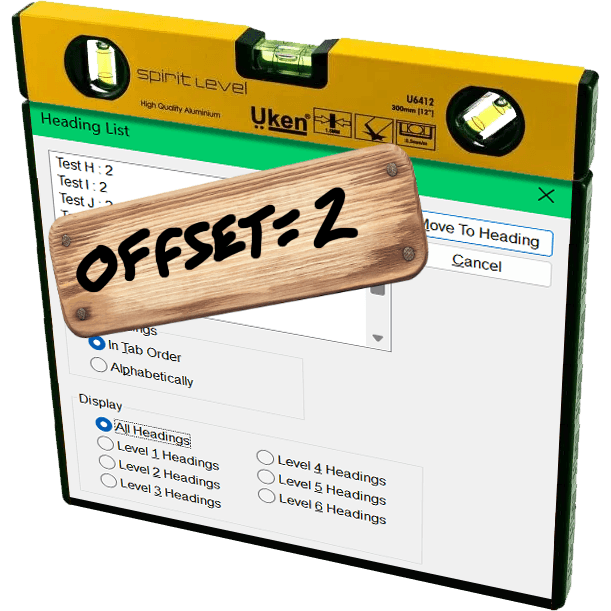
The JAWS heading list dialog with a yellow three-in-one surface level resting on top and a board nailed over it with hand-scrawled ‘offset=2’.

The proposed Document Outline Algorithm, where headings would automatically reset themselves to the appropriate level based on their position in the DOM structure, was never part of a final HTML specification. It was quickly proven to be unworkable; brief support in JAWS demonstrated that. You can read the tortured history (and a JAWS support demo) in my 2016 post There Is No Document Outline Algorithm.

In 2019 WHATWG worked to resurrect <hgroup>, partly in a novel effort to try to resurrect the Document Outline Algorithm. In the end, even that effort was futile. <hgroup> came back, but it came back as a grouping element only. The only impact it has on heading structures is that browser could, if they really wanted, ignore other headings in the same <hgroup>.

In 2020, Steve Faulkner wrote about the doc-subtitle role, from the Digital Publishing WAI-ARIA Module 1.0, as a way to handle subtitles until <hgroup> found its new footing. Sadly, a cadre of authors thought that role could be the basis for the Document Outline Algorithm.

Authors very much want to make the browser decide heading levels for them. Authors also very much continue to write content and HTML structures that make that impossible.

So I wasn’t surprised when Firefox’s recent announcement of headingoffset support coming to Firefox behind a flag resulted in many cheering the “return” (irony quotes) of the Document Outline Algorithm.

But it isn’t.

headingoffset

The headingoffset attribute lets authors offset heading levels for descendants of a given node.

So if you have, say a dialog that starts at <h2>, you could add headingoffset="2" and then let it pull in (server-side or via your preferred user-slowing front-end tooling) another page that uses <h1> as its first heading, you can be comfortable knowing that <h1> will be treated as <h3> in the accessibility tree.

This can be handy for content re-use without authors needing to make every heading a variable or burning down the DOM each time to forcibly re-write them.

But it’s still the author’s job to make an intentional and good decision. The browser will know nothing more about your content or structure than it did before. And it certainly doesn’t reduce WCAG risk.

Other useful nuggets:

  • headingoffset values must be valid non-negative integers.
  • headingoffset values must be between 0 and 8.
  • headingoffset values greater than 8 are specified to max at level 9, but existing bugs may impact that.
  • Other invalid headingoffset values should fall back to level 2, but again, bugs and implementation decisions wil impact that.
  • headingreset is a boolean attribute that tells browsers to ignore headingoffset for that node and its descendants.
  • Do not use headingoffset until you can confirm support for the computed heading level in your target audience browser.

Recap

  1. headingoffset is not the (nor any) Document Outline Algorithm, nor does it replicate it.
  2. headingoffset requires the author to make decisions based on content.
  3. Until JAWS and TalkBack fix existing bugs, probably don’t do / allow any heading levels higher than 6.
  4. Don’t do / allow any heading levels higher than 9.
  5. If you are hoping headingoffset will resolve your heading level problems in a hands-off way with imported or user-generated content, you may end up creating confusion and WCAG risk.
  6. Do not try to use headingoffset to try to recreate the Document Outline Algorithm.

Related

Not a ton of detail in this post, but at 500 words if you want more then here are some resources beyond what I linked:

  •  

Maybe Don’t Rely on Google’s “Modern Web Guidance”

Just in time for Google I/O, the Chrome for Developers site announced Modern Web Guidance (MWG):

Orange star between two curly braces, topped with a circle-line and a flat line at the bottom, appearing almost as an ASCII art lantern.

Modern Web Guidance is a set of evergreen and expert-vetted skills that guide your AI coding agents across many common use cases to build modern web experiences that are accessible, performant, and secure.

I appreciate this set of LLM skills lists accessibility first, something I feel strongly every MVP (or early preview as Google calls this) must:

Simply, if your MVP does not have accessibility factored in, it is not viable. If you claim accessibility is a core principle but your version 0 does not include it, then it is not a core principle.

Last year I made a straightforward and simple request to Google (that also respects the law in most jurisdictions where Google does business):

Please, if your team cannot explain how the thing satisfies all WCAG Success Criteria at Level AA, then don’t release the thing.

Unfortunately, MWG accessibility doesn’t satisfy. Partly because not every pattern has tailored guidance. For example, you may remember when Google ran at a toast pattern before abandoning it:

Again, the people designing the feature neither understood accessibility nor had consulted anyone who did while they designed it, instead relegating accessibility to the later stages of their design and assuming it could simply be remediated with a modest effort and without any serious redesign or rethink.

I hoped Google also remembered and applied that experience here, making a skill tailored to toasts to avoid another debacle. Nope.

Reopening because this guide needs accessibility guidance in some form as there’s no general toast guidance.

22 May comment reopening issue #393 “Create guide and evals for the persistent-toast-notifications use case,” originally marked complete 4 April 2026

But this is an early preview of what developers can do with MWG. It’s not going to cover every pattern. That would be absurd. So let’s look to a pattern Google decided to showcase at launch via this first example prompt on the page:

Create an accordion-style stats component that smoothly animates on open and close.

First prompt on MWG home page, under Build new user experiences heading.

I expected a pile of <details name> elements, maybe CSS block-size with a JavaScript fallback, probably a couple placeholder images for generic stats, possibly a well-formed table to accompany them, and of course all of it passing WCAG. This is what Antigravity produced with MWG:

See the Pen Google Modern Web Accordion by Adrian Roselli (@aardrian) on CodePen.

Antigravity with MWG went well beyond the prompt, providing a theme switcher, configuration settings, and plenty of calls to Google fonts. But it failed to do what I asked. The animation doesn’t work in Firefox. This despite the promise of baseline / Baseline support and fallbacks:

  • Progressive Enhancement & Nuanced Fallbacks: We distinguish between purely additive enhancements (like speculative preloading) which are safe to let older browsers silently ignore, and critical behaviors (like dialog controls or network beacons) where we write highly considered, low-overhead fallbacks.
  • […]
  • Baseline-Aware Integration: We leverage real-time compatibility data from the Baseline project so agents can dynamically adapt to current browser support and any browser support preferences.

This is already worrisome given we know that three years on, Baseline still doesn’t really address baseline support:

The relatively new Web Platform Baseline offering does not track browser support for accessibility features built into the web platform. If you need to understand whether browsers support accessibility features as your own base level set of requirements, for legal or other compliance reasons, then Web Platform Baseline does not represent a baseline.

Let’s ignore the non-DRY code, like duplicated HTML text in the script and stringing out the transition instead of using transition-property. Antigravity with MWG didn’t even create a WCAG-conformant example from its own prompt. I found errors within moments. MWG failed its core promises of creating accessible and performant code. Despite its own explicit guidance.

For the first two of these MWG already had guidance, and the a11y skill just wasn’t picked up. Overall activation aside, this highlights the importance of including contextual a11y information.

[…] [W]e should try to have one guide for each common interactive element summarizing and linking/embedding relevant bits of guidance (e.g. tabs, accordions, drawers, etc). The more scattered the use case guidance is, the less likely it is that agents will actually pick up all the pieces.

And there’s the rub. There’s no way to guarantee you’ll get what you ask for, that you won’t get something else, and that these guides — the entire promise of MWG — will be honored. MWG asks authors to trust MWG when using an LLM to code interfaces. But MWG knows its guidance may be ignored:

LLMs are non-deterministic. Even if we do everything right, there is no guarantee any guideline will be used for any given prompt. Even if the relevant guide is picked up, it may not be read fully. Case in point: As you say, MWG already had guidelines for many of these things!

Mastodon post from a domain expert consultant to Google for MWG, 21 May 2026

The underlying code generation technology can’t be trusted to follow the rules and the rules aren’t robust enough to blunt that reality.

Crude orange Vonnegut-style asterisk between two curly braces angled out a bit, topped with a rounded rectangle and a curved line at the bottom, appearing almost as an ASCII art toilet.

If your job requires you to burn tokens to satisfy some manager’s dashboard, then yes, grab the MWD skills files and integrate them into your LLM work. You’ll almost definitely get better output than if you do nothing at all. There are smart people working on this and many of the accessibility rules I saw were on-point.

But that output will be wrong in subtler and more nuanced ways across potentially fatter piles of code with more unrelated output and unwanted dependencies. It will require a more specialized set of skills to identify errors. And those errors will be different every time the code is generated.

So on the side, keep supporting any existing pattern library. If it’s built well, it’s copy-ready code that you can stuff into a project just as quickly as a chatbot could generate it. It’s deterministic, so you get the same code every time. Ideally it’s been vetted, so you don’t need to look for errors. It’s tailored to your context, meaning you don’t need to yank out random style switchers and typefaces (hoping you got all the dependencies).

If your job doesn’t require you to burn tokens, then probably ignore MWG and, by extensions, LLM for code. In case the environmental damage, intellectual property theft, wealth redistribution to the rich, encoded biases, and built-in support of fascism weren’t enough.

Update: 24 June 2026

The Silktide blog has this banger of a quote:

Across the board, [Google Antigravity using Modern Web Guidance] was a deprioritization of accessibility requirements in favor of visual presentation.

I don’t agree Antigravity nor MWG should use APG, which a regular visitor here may know, but the author is correct the APG disclosure pattern is mostly harmless.

But Silktide is right that the, once again, Google built the wrong thing for the wrong people and then proudly shoved it out into the world with no hint of self-awareness.

  •  

WCAG3 Contrast as of April 2026

For years I have seen people, teams, products, organizations, and projects promoting APCA contrast as the WCAG3 color contrast algorithm. In many of those cases, those same actors have suggested dismissing the contrast algorithm in WCAG2.

This kind of problematic advice happened so often that I started filing issues with tool makers to remove APCA, as with this May 2024 Chromium issue.

In January 2025 I saw a post promoting that advice, which would create legal risk for anyone following it. You can see my original 2025 response on Mastodon and the same post on Bluesky, where the creator of APCA also weighed in. Read those to ensure you aren’t just taking my word for it.

Current Situation

Here is the most current (as of this writing) contrast ratio algorithm in WCAG3 with the salient bit highlighted:

contrast ratio test Exploratory

meeting a sufficient level of contrast between two colors using the relationship of hue, saturation, and lightness values

Editor’s note

The contrast algorithm used in WCAG 3 is yet to be determined.

APCA was marked for removal in early 2023:

Exploratory content that does not gain WG support to proceed to the next stage within 6 months is automatically removed in the WCAG 3 development process. We still hope the promising contrast work will continue to mature for potential later inclusion.

As with other WCAG3 ideas that did not get working group support, the working group pulled it from the July 2023 WCAG3 working draft. APCA was only ever exploratory, and the W3C’s July 2023 update explained removal of exploratory items. The APCA creator’s response to Michael Cooper’s comment acknowledged that APCA versions in the draft were all early versions that were very obsolete (emphasis theirs).

I have no idea if APCA, whatever version, will come back to WCAG3.

What to Do?

The W3C logo with a frog-headed eyedropper over it. You can still use APCA (whatever version). If you do, limit your risk by taking one of these approaches:

  • Choose colors that also conform to WCAG2 contrast requirements; or
  • If you pick colors that fail WCAG2 contrast requirements, document it and have a ready response should you receive a drive-by lawsuit from a bad actor using an automated checker to find a contrast violation (assuming your attorney lets you do this).

I am still not a (bird) lawyer.

In the meantime, WCAG3 is years away from being done, perhaps 2030 at the soonest. Any contrast algorithm it picks won’t be final until at least then. But if you like whatever is proposed and want to use it before 2030, then probably refer to my two approaches above.

  •  

My Request to Google on Accessibility

Hey, Alphabet or Google or Chrome or whomever in that illegal monopoly continues to release things to the web platform that are full of accessibility barriers, I have what I think is a straightforward request.

My Request

Please, if your team cannot explain how the thing satisfies all WCAG Success Criteria at Level AA, then don’t release the thing.

If the thing is a new feature for the web platform (HTML, CSS, ARIA, SVG, etc.), then don’t even propose the thing until you have its WCAG conformance sorted.

Then understand WCAG is the bare minimum, is only table stakes, and does not in itself guarantee the thing is accessible. Which means be prepared for the thing to still contain barriers that must be addressed before it goes any further. Which means you’ll field some questions.

Blowback

I’ll run with two examples lead by Google in the web platform standards world, one older and one recent.

1. Toasts

In 2019 I got involved in a Google-lead effort to create a toast element (sorta). I gave ARIA feedback, helped make the GitHub content more accessible, and challenged some assumptions (primarily what they called research). I commented on only three other issues. Those links cover the totality of my involvement.

The toast effort died on the vine, I believe because it wasn’t well-scoped. And I got blamed for it (for being negative, disingenuous) and apparently I also never apologized. I wrote about this experience in more detail at Scraping Burned Toast.

2. Carousels

In late 2024, doing an end-run around the HTML spec and the concept of separation of concerns, Google drove carousels in the CSS Working Group. Then accessibility experts got wind of it and weighed in (more than just the once), only to get no traction.

Instead, Chrome did a dog-n-pony show (with the requisite accessibility lies). Prominent voices promoted it, some wrongly cooed over its accessibility, but only one person took the time to actually try it — and found it wanting. She got sideways criticism for a 6,000-word post and the implication that accessibility experts didn’t do enough. Who could have predicted?

Book-ends

Both of these book-end five years of a consistent experience for me (15 years based on posts linked below). Accessibility experts and disabled users (and the wonderful overlap of both groups) are not consulted at the start. Not in the scoping, not in the research, and not even in traditional shift-left-but-not-left-enough design phase.

Instead, we stumble across these things. We raise alarms or concerns or questions and are seen as buzzkills. Fun police. Hindrance to progress. We flag barriers and are ignored or dismissed or even harassed. And when the project inevitably catches fire, despite claims accessibility is baked in or the assertion it’s only a beta, we are told we didn’t weigh in early enough. We didn’t donate enough time. We didn’t participate in whatever opaque process in our copious free time.

Of course, ableism makes it easy to forget that accessibility experts and disabled users are already under a constant DDoS attack for our attention, never mind dealing with a US federal government that wants us to go away. I know I said I’m good at being a party-pooper, but I don’t want to be. It’s draining. And frankly, Google, it’s your fault (though not yours alone).

A Brief and Select History of WTF

Lucy, labeled “megacorp,” teeing up a football, and shouting at Charlie Brown, who is labeled “accessibility practitioner,” his back turned, arms folded, and grumpy expression.
Image idea courtesy Eric Bailey.

Wrap-up

Do you work for the company that formerly claimed it wouldn’t do evil? It sucks if you take this as a personal attack. It’s not. Your employer is simply doing a terrible job of supporting you in your efforts to support disabled users. If you want to be angry or frustrated, be angry or frustrated at the multi-billion dollar company that keeps throwing up barriers instead of spending a negligible amount of money to get experts and users involved.

It’s a paycheck that puts food on the table. I get that. Take its money and do what you can.

If you work for not-Google, like, say, Apple or Microsoft or Meta or Adobe or whatever, don’t be smug. If I had the energy I could take all of your employers to task for similar, egregious violations of user trust.

I did this rant in only one thousand and seven words!

Related

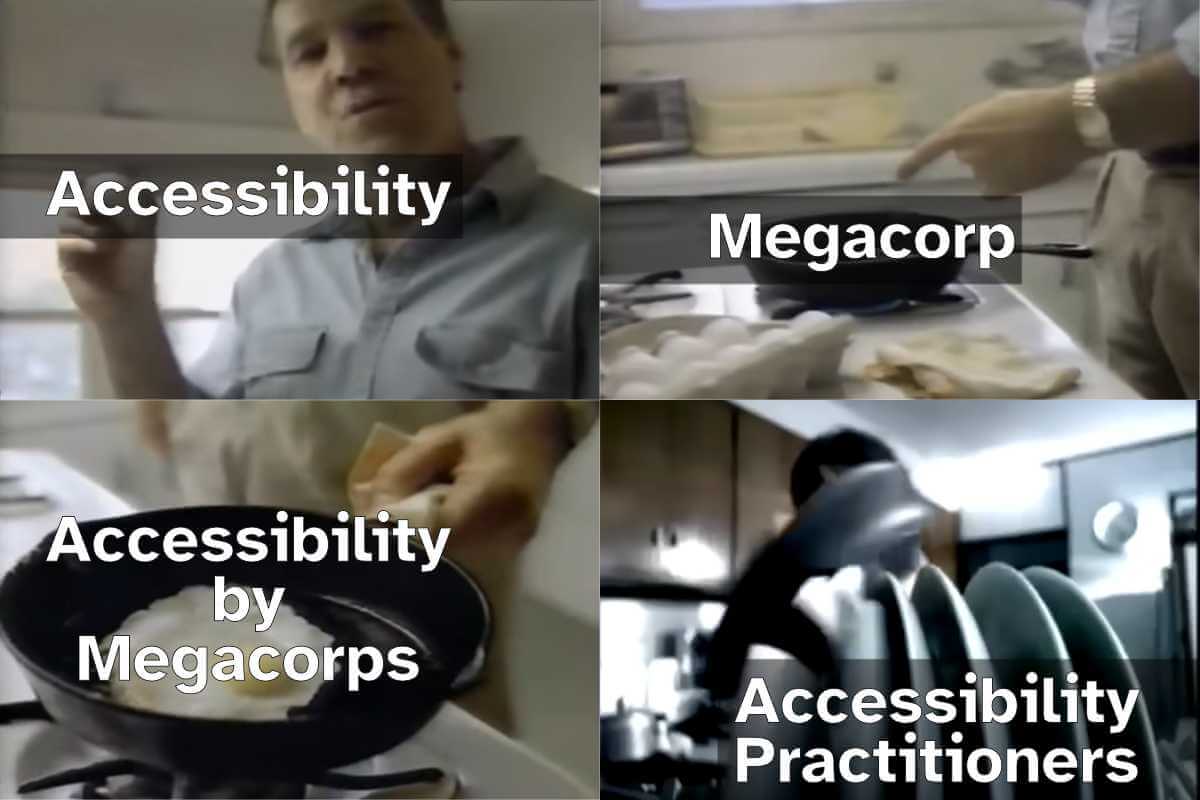
A man holding an egg labeled “accessibility;” pointing at a skillet labeled “megacorps;” the fried egg in the pan labeled “accessibility by megacorps;” a woman swinging the skillet through a rack of dishes where the broken dishes are labeled “accessibility practitioners.”
Stills from the original “This is your brain on drugs” 1980s anti-drug commercial with the final still from the Rachael Leigh Cook version.

More of where I’ve tracked when Google has broken, dismissed, or forgotten accessibility and users.

Update: 28 May 2025

Eric Bailey made a point about conference-driven development, essentially rushing broken or half-baked features out the door so the megacorp would have something to reveal on stage.

I think he was right. On 21 May, CSS carousels featured at Google I/O. The comparison example was Elementor, which ignores the more compelling question (to me) of why Elementor needed 165kb of JavaScript for a carousel. It also ignores the very real risk of WCAG violations and the larger question of why Elementor would make such profound claims when only one browser supports the feature.

Also consider the follow-on comment from the Google presenter, that the CSSWG is already looking ahead to exploring things like bringing your own custom elements for buttons and markers and native cyclical scrolling. The CSSWG may be the vehicle where Google continues to exert its dominance over web standards, separation of concerns and accessibility be damned.

Update: 6 June 2025

David Bushell highlights something with which I agree and which I don’t think gets enough attention — ::pseudo-elements?. He points out it’s a clear violation of separation of concerns (which should sound familiar) and reminds of localization risks (something I would think a Working Group would consider). Google’s rush to market has left many obvious gaps, and I rather hope Google stops doing that seemingly every quarter / conference cycle.

Update: 11 August 2025

I added the Google-lead Open-UI proposal #1193 [menu] Navigation vs menu items use case item above.

Update: 30 September 2025

In The Need for Accessibility Excellence, Devin Prater points out Gemini’s accessibility failures on Android (versus iOS), significant gaps in TalkBack, frustrations with Google Play Books, hassles with Gmail on Android, barriers in gaming on Android, and the seeming abandonment of Accessibility Tags in Google Play.

This isn’t about pointing fingers or assigning blame. It’s about recognizing a pattern of inconsistency and demanding a higher standard. How can we expect small companies or indie developers to make their apps accessible, when we can’t get Google to listen to us and take us seriously?

And that’s the thrust of it. When developers continue to justify their decisions because Google did it, that lowers the experience for everyone.

  •  
❌