Un outil n'a sa place dans une agence que s'il nourrit sa mémoire ou qu'un agent IA peut s'y brancher. Marie Robin, fondatrice de Fleet Forward, livre les 10 abonnements qu'elle garderait si elle devait résilier tous les autres.
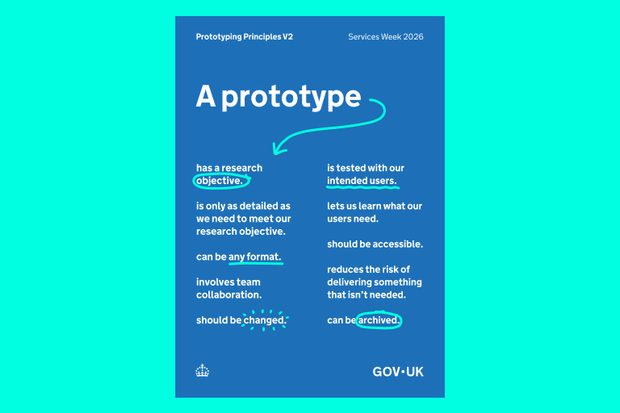
A prototype is a way to learn something before making a bigger commitment. When designing services, many of the things we need to test are intangible: policies, processes, conversations, operating models. A prototype can go beyond the screen - we can prototype with an email, text message, or an event.
The GOV.UK Service Manual outlines: ‘You must make prototypes of your service to explore, share and test different designs before you commit to building anything. You can quickly make and test multiple prototypes and discard the ones that do not test well. You should use the prototype that best meets your needs at the time.’
Digital prototyping tools have become more accessible. New AI-assisted tools may also help teams explore and visualise ideas more quickly. But while the tools have changed, the purpose and principles of prototyping have not.
A prototype can be anything
As long as a person uses it, and we learn something.
We need shared principles that help teams focus on finding out what they need to know in order to move forward. Prototyping is about learning rather than producing artefacts.
At Services Week 2026, we hosted an interactive session on the ‘Principles of Prototyping’. Rather than presenting a finished set of principles, we shared a draft list of principles and invited people from across government to test, critique and improve it. Thank you to the 124 people who contributed. The 9 principles below are the result of that session.
9 Principles of prototyping
1. A prototype answers a question.
Before creating a prototype, think about the questions you need to answer to make a decision and move forward. To develop these questions, you could involve a designer, a user researcher, a product manager and other members of the team.
2. A prototype is only as detailed as we need to answer our question.
If we know the research question we are trying to answer, we can create a prototype that helps us answer that question. The prototype does not necessarily need to be complex to answer a simple question. This is particularly true in the early stages of developing a service.
3. A prototype can be any format.
A prototype does not always have to be digital. A prototype can be a blog post, or a word document that people use and give feedback on.
4. A prototype is tested with people who will use the service.
A prototype is tested with the people who are going to use the future service; that’s how we learn. We can find ways to meet these people where they are.
At NHS Digital, Rhiannon Smith, Content Designer for NHS.UK worked on making content about skin symptoms more inclusive. Before the improvements, skin symptoms were mostly described in terms of how they appear on white skin. The team improved the content and tested it with the people who use the website to get their feedback. You can read more about this case study on the NHS Digital blog.
5. A prototype is accessible.
A prototype should be accessible. If we use an event as a prototype for a service we are developing, the event should be held in a venue that is accessible for all, particularly for the users that will be accessing the service. If we use an email as a way of prototyping a bit of communication around a service, that email should be written in a way that everyone can understand.
6. A prototype involves team collaboration.
Prototyping is not only the domain of interaction designers and service designers. It also involves user researchers, product managers and policy experts. A policy expert could prototype a piece of policy and then show it to the people who would be affected by that policy for feedback. Or a designer could create a prototype with input from lots of colleagues about what they need to find out.
An example of this is the multidisciplinary team from Camden Council who formed to redesign debt support in Camden. The team included a service designer, design researcher, officers, money and debt advisors, and policy experts. You can read more about this case study on the Change by Design blog.
7. A prototype reduces the risk of delivering something that is not needed.
The intention of prototyping is to understand if something is needed, create a service that works for people, and to learn about risks early. If a prototype causes an unintended consequence, it’s useful to know that early in the process rather than finding out when something is fully live. It's also useful to understand people’s reactions to a prototype to understand if it meets their needs. The service may need to change to meet people's needs.
8. A prototype should be changed.
As we learn from the prototyping process and get feedback from people, we should change and iterate the prototype. A prototype is not intended as a finished artefact. The change can be small, such as revising the wording to make something clearer. Or it can be big, for instance by providing a piece of information via email as well as text message so that people can understand it better.
9. A prototype can be archived.
Sometimes a prototype leads to a change in a live service. Sometimes a prototype leads to a completely new service or policy being developed. Or we learn that the prototype does not achieve goals the team is trying to achieve. If this happens, it’s good to share the knowledge with people, write down why the prototype is not being taken forward, and don’t be afraid to archive it.
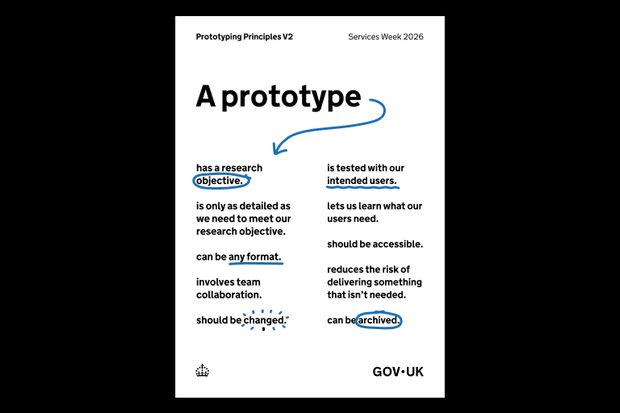
These principles can be downloaded as posters at the links below. Use the principles with your team to plan prototypes, test assumptions and reduce delivery risk.
Oui, parce que si les emoji existent comme ça, c'est qu'il y a plein de raisons.
Cela fait trop longtemps que je n'ai pas écrit sur ce blog. Le manque de temps, le fait que pour parler technique, je privilégie mon émission radio CPU, le manque parfois d'envie.
Alors réveillons-le comme une sorte de brouillons pour mes futurs sujets, pour des à-côtés, ou simplement comme ça, dire que je suis toujours là.
Certains le savent, je manipule les emoji depuis 1999. Oui, depuis aussi longtemps, et les traces sont sur ce site web. Cela a été l'objet d'une de mes premières conférences techniques en 2012, adaptation d'une série de billets persos Des emoji dans l'Unicode. D'une manière assez amusante, on m'a cité une fois en entretien d'embauche mon propre sujet en ignorant que j'en étais le rédacteur. J'ai eu aussi des informations précieuses de première main, parfois très drôles, et j'ai toujours envie de raconter cette épopée des emoji dans l'Unicode et les implications techniques.
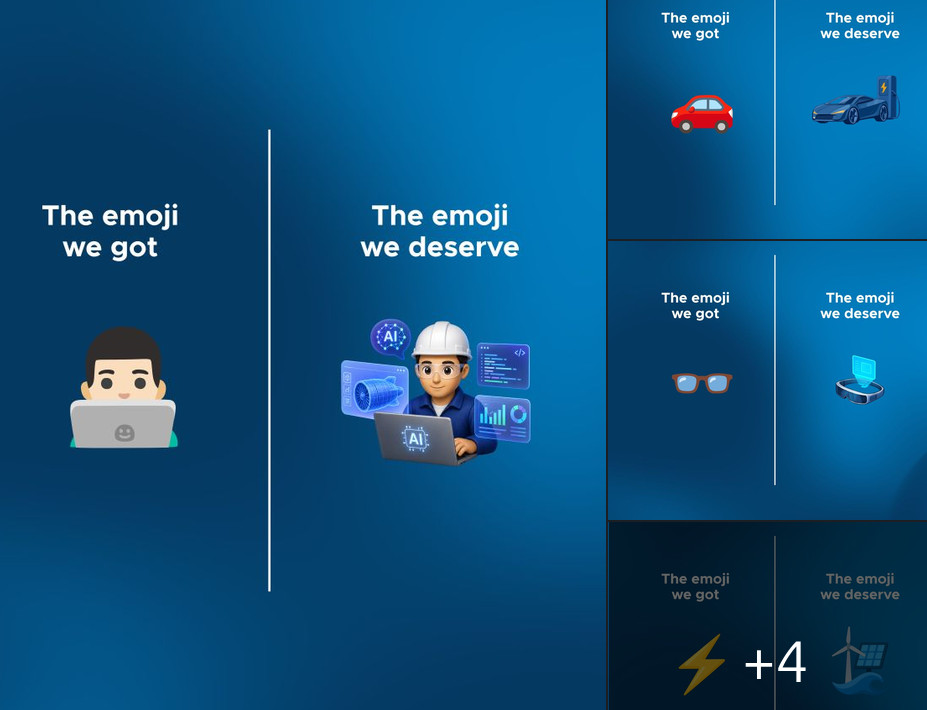
The emojis we got vs. the emojis we deserve 💭
The world is evolving faster than ever. New technologies, smarter engineering, cleaner energy and more connected industries are just some of the advances impacting our everyday lives.
However, most of the emojis available don’t represent these innovations… So we decided to take the matter into our own hands and create the versions that would best fit the ALTEN approach!
Take a look at our refreshed emojis. 👇🏻
Suivi d'une collection d'images opposant des emoji de la fonte Google Noto (donc Android ?) à leur réinterprétation par IA générative. Par exemple, une personne derrière un laptop revu dans un environnement holographique, ou une paire de lunettes revue en dispositif de Réalité Augmentée
Pour une boite spécialisée dans l'ingénierie informatique, ne pas avoir compris pourquoi et comment les emoji existent, les contraintes optiques, les usages directs, le besoin d'abstraction, tout cela pour s'exprimer graphiquement par des images générées par IA,…
Qu'en 3 petits prompts pour générer ton post sur LinkedIn pour faire plus joli plus rapide sans en comprendre contraintes et complexité, cela laisse rêveur.
C'est encore plus drôle quand ce post arrive une semaine après que, dans un spectaculaire retour en arrière, LinkedIn supprime ses outils d'amélioration par Copilot des contenus et propose maintenant de filtrer et modérer fortement tout contenu post généré par IA, constatant que c'était devenu infernal.

 Connexion

 Un outil n'a sa place dans une agence que s'il nourrit sa mémoire ou qu'un agent IA peut s'y brancher. Marie Robin, fondatrice de Fleet Forward, livre les 10 abonnements qu'elle garderait si elle devait résilier tous les autres.